
 https://doi.org/10.4081/jlimnol.2026.2256
Environmental and community constraints on Elodea nuttallii: implications for early season control in an urban stretch of the Po River (NW Italy)
All claims expressed in this article are solely those of the authors and do not necessarily represent those of their affiliated organizations, or those of the publisher, the editors and the reviewers. Any product that may be evaluated in this article or claim that may be made by its manufacturer is not guaranteed or endorsed by the publisher.
Accepted: 5 February 2026
Published: 15 April 2026
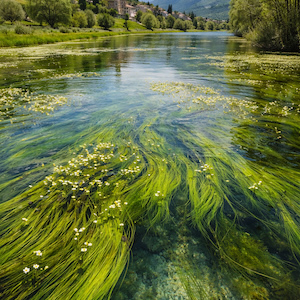
Invasive aquatic macrophytes represent an increasing concern for freshwater ecosystems, where they alter biodiversity, ecosystem functioning, and water-related services. Among them, the submerged species Elodea nuttallii has rapidly expanded across many European waterbodies, yet its ecology in regulated lowland rivers remains insufficiently explored, particularly compared to that in artificial canals, ponds, and lakes. This study investigates the environmental, hydrological, and biotic factors shaping the occurrence and distribution of E. nuttallii in an urban river system. Field surveys conducted in 2025 documented macrophyte assemblages and habitat conditions in the Po River, the longest Italian river, flowing through the city of Turin. A total of 150 presence-absence points for E. nuttallii were recorded, spaced at least 200 meters apart, along the urban stretch of the river, collecting information on temperature, dissolved oxygen, pH, conductivity, as well as the presence of other macrophytes and the extent of plant populations. The results show that most vegetated patches are dominated by E. nuttallii, which is associated with depositional areas characterised by soft sediments and significantly related to the presence of Myriophyllum spicatum, as demonstrated by Phi correlation analysis. Although interspecific competition appears to limit E. nuttallii’s relative abundance during the seasonal macrophyte community peak, when its mean relative cover drops from 89.2% to 60%, its extended vegetative season likely contributes to its persistence. Moreover, substrate type emerged as the primary abiotic factor shaping spatial distribution in a regulated lowland river, with sand and silt providing optimal conditions for its establishment. We further highlight the need for early season and site-specific management interventions. Given the ecological and recreational significance of the Po River and its role as a dispersal corridor, understanding the invasion dynamics of E. nuttallii is critical for informing management strategies, particularly in light of its designation as an EU-priority alien invasive species.
Downloads
Aree protette Po Piemontese, 2023. [La vegetazione acquatica del Po. La minaccia delle specie esotiche invasive. Elodea nuttallii: biologia della specie ed azioni a contrasto].[in Italian]. Accessed: 7 January 2026. Available from: https://www.parcopopiemontese.it/news-dettaglio.php?id=74773
ARPA Piemonte, 2025. [Idrologia – Acque superficiali].[in Italian]. Accessed: 7 January 2026. Available from: https://www.arpa.piemonte.it/temi/acqua/idrologia-acque-superficiali
Arts GHP, Smeden J, Wolters MF, Belgers JDM, Matser AM, Hommen U, et al., 2022. Seasonal dynamics of the macrophyte test species Myriophyllum spicatum over two years in experimental ditches for population modelling application in risk assessment. Integr Environ Assess Manag 18:1375-1386. DOI: https://doi.org/10.1002/ieam.4553
Atapaththu KSS, Asaeda T, 2015. Growth and stress responses of Nuttall’s waterweed Elodea nuttallii (Planch) St. John to water movements. Hydrobiologia 747:217-233. DOI: https://doi.org/10.1007/s10750-014-2141-9
Bolpagni R, 2021. Towards global dominance of invasive alien plants in freshwater ecosystems: the dawn of the Exocene? Hydrobiologia 848:2259-2279. DOI: https://doi.org/10.1007/s10750-020-04490-w
Bolpagni R, Racchetti E, Laini A, 2016. Fragmentation and groundwater supply as major drivers of algal and plant diversity and relative cover dynamics along a highly modified lowland river. Sci Total Environ 568:875-884. DOI: https://doi.org/10.1016/j.scitotenv.2016.06.070
Bolpagni R, Azzella MM, Agostinelli C, Beghi A, Bettoni E, Brusa G, et al., 2017. Integrating the Water Framework Directive into the Habitats Directive: Analysis of distribution patterns of lacustrine EU habitats in lakes of Lombardy (northern Italy). J Limnol 76:1627. DOI: https://doi.org/10.4081/jlimnol.2017.1627
Bouma TJ, De Vries MB, Herman PMJ, 2010. Comparing ecosystem engineering efficiency of two plant species with contrasting growth strategies. Ecology 91:2696-2704. DOI: https://doi.org/10.1890/09-0690.1
Bučar M, Rimac A, Šegota V, Vuković N, Alegro A, 2024. Ecology of Elodea canadensis Michx. and Elodea nuttallii (Planch.) H. St. John—Insights from National Water Monitoring in Croatia. Plants 13:1624. DOI: https://doi.org/10.3390/plants13121624
Buccheri M, Boscutti F, Pellegrini E, Martini F, 2019. [La flora aliena nel Friuli Venezia Giulia].[Article in Italian]. Gortania 40:7-78.
Buldrini F, Pezzi G, Barbero M, Alessandrini A, Amedei L, Andreatta S, et al., 2023. The invasion history of Elodea canadensis and E. nuttallii (Hydrocharitaceae) in Italy from herbarium accessions, field records and historical literature. Biol Invasions 25:827-846. DOI: https://doi.org/10.1007/s10530-022-02949-6
Crane K, Kregting L, Coughlan NE, Cuthbert RN, Ricciardi A, MacIsaac HJ, et al., 2022. Abiotic and biotic correlates of the occurrence, extent and cover of invasive aquatic Elodea nuttallii. Freshwater Biol 67:1559-1570. DOI: https://doi.org/10.1111/fwb.13960
Desfayes M, 1995. [Appunti floristici sulle acque del Trentino e territori circostanti].[Article in Italian]. Ann Mus Rov 10:223-248.
Di Nino F, Thiébaut G, Muller S, 2005. Response of Elodea nuttallii (Planch.) H. St. John to manual harvesting in the North-East of France. Hydrobiologia 551:147-157. DOI: https://doi.org/10.1007/s10750-005-4457-y
Emery‐Butcher HE, Beatty SJ, Robson BJ, 2020. The impacts of invasive ecosystem engineers in freshwaters: A review. Freshwater Biol 65:999-1015. DOI: https://doi.org/10.1111/fwb.13479
ENEA, 2022. [Fiume Po: intervento sperimentale di estirpazione della vegetazione esotica].[in Italian]. Accessed: 7 January 2026. Available from: https://sostenibilita.enea.it/news/fiume-po-intervento-sperimentale-estirpazione-vegetazione-esotica
European Commission, 2014. Regulation (EU) No 1143/2014 of the European Parliament and of the Council of 22 October 2014 on the prevention and management of the introduction and spread of invasive alien species. Available from: https://eur-lex.europa.eu/legal-content/EN/TXT/PDF/?uri=CELEX:32014R1143
Gao J, Hu W, 2023. A bibliometric analysis of lake restoration with submerged macrophytes. Water 15:2411. DOI: https://doi.org/10.3390/w15132411
Gross EM, Bakker ES, 2012. The role of plant secondary metabolites in freshwater macrophyte–herbivore interactions: limited or unexplored chemical defences?, pp. 154-169. In: Iason GR, Dicke M, Hartley SE (eds.), The ecology of plant secondary metabolites: from genes to global processes. Ecological Reviews. Cambridge University Press, Cambridge. DOI: https://doi.org/10.1017/CBO9780511675751.009
Intergovernmental Science-Policy Platform on Biodiversity and Ecosystem Services (IPBES), 2023. Accessed: 7 January 2026. Available from: https://www.ipbes.net/
International Union for Conservation of Nature (IUCN), 2023. Invasive alien species. Accessed: 7 January 2026. Available from: https://www.iucn.org/our-work/topic/invasive-alien-species
IRSA, 2004. [Metodi analitici per le acque – Sezione 2000].[in Italian]. Manuals and guidelines APAT, 29/2003.
ISPRA, 2007. [Metodi biologici per le acque superficiali interne – Macrofite].[in Italian]. Manuali e Linee guida. Rome, ISPRA.
Jeong S, Yang D, Joo S, Park S, 2021. Allelopathic inhibition effects of Myriophyllum spicatum on growths of bloom-forming cyanobacteria and other phytoplankton species in coexistence experiments. J Plant Biol 64:501-510. DOI: https://doi.org/10.1007/s12374-021-09322-5
Kelly R, Harrod C, Maggs CA, Reid N, 2015. Effects of Elodea nuttallii on temperate freshwater plants, microalgae and invertebrates: small differences between invaded and uninvaded areas. Biol Invasions 17:2123-2138. DOI: https://doi.org/10.1007/s10530-015-0865-8
Marbuah G, Gren IM, Tattersdill K, McKie BG, 2019. Management of an aquatic invasive weed with uncertain benefits and damage costs: The case of Elodea canadensis in Sweden. Water Econ Policy 5:1850025. DOI: https://doi.org/10.1142/S2382624X1850025X
Grudnik MZ, Germ M, 2013. Spatial pattern of native species Myriophyllum spicatum and invasive alien species Elodea nuttallii after introduction of the latter one into the Drava River (Slovenia). Biologia 68:202-209. DOI: https://doi.org/10.2478/s11756-013-0006-8
Grudnik ZM, Jelenko I, Germ M, 2014. Influence of abiotic factors on invasive behaviour of alien species Elodea nuttallii in the Drava River (Slovenia). Ann Limnol-Int J Limnol 50:1-8. DOI: https://doi.org/10.1051/limn/2013065
Millane M, Caffrey J, O’Flynn C, 2016. Risk Assessment of Elodea nuttallii – submission for consideration of Union listing under EU IAS Regulation No. 1143/2014. EU amended template for submission February. Version 1.2.1.
Kolada A, Pasztaleniec A, Bielczyńska A, Kutyła S, 2022. Taking over the dominance of the macrophyte community by Elodea nuttallii (Planch.) H. St. John is poorly reflected in ecological status assessment results. Aquat Invasions 17:516-542. DOI: https://doi.org/10.3391/ai.2022.17.4.04
Kunii H, 1982. The critical water temperature for the active growth of Elodea nuttallii (Planch.) St. John. Jap J Ecol 32:111-112.
Kuriata-Potasznik A, Szymczyk S, Pilejczyk D, 2018. Effect of bottom sediments on the nutrient and metal concentration in macrophytes of river-lake systems. Ann Limnol-Int J Limnol 54:1. DOI: https://doi.org/10.1051/limn/2017028
Petruzzella A, Manschot J, van Leeuwen CHA, Grutters BMC, Bakker ES, 2018. Mechanisms of Invasion Resistance of Aquatic Plant Communities. Front Plant Sci 9:134. DOI: https://doi.org/10.3389/fpls.2018.00134
Qi Y, Zhang Y, Xue J, Zhang Z, Cao J, Yang N, et al., 2025. Future climate change increases the risk of suitable habitats for the invasive macrophyte Elodea nuttallii. Biology 14:504. DOI: https://doi.org/10.3390/biology14050504
R Core Team, 2022. R: A Language and Environment for Statistical Computing, version 4.2.0. Available from: https://search.gesis.org/publication/zis-RCoreTeam.2022R
Regione Piemonte, 2023. [Individuazione dei beneficiari e dei progetti inerenti l'eradicazione/gestione delle specie esotiche invasive di interesse unionale, ai sensi della D.G.R. n. 8 - 6354 del 28/12/2022. Riduzione della prenotazione di impegno sul capitolo 140546 e conseguente impegno di spesa sul bilancio di previsione finanziario 2022 - 2024, annualità 2023].[Regional Law in Italian]. DD 159/A1601C/2023.
Regione Piemonte, 2024. [Scheda monografica Elodea nuttallii].[in Italian]. Turin, Gruppo di Lavoro Specie Esotiche della Regione Piemonte. Available from: https://www.regione.piemonte.it/web/media/32551/download
Selvaggi A, Dellavedova R, 2016. [Note floristiche piemontesi: 747. Elodea nuttallii (Planch.) H. St. John (Hydrocharitaceae)]. In: Selvaggi A, Soldano A, Pascale M, Dellavedova R (eds.), [Note floristiche piemontesi n. 706-773].[in Italian]. Riv Piem Stor Nat 37:349.
SunCalc, 2025. SunCalc web application. Accessed 7 January 2026. Available from: https://www.suncalc.org/#/45.0684,7.6831,11/2025.11.21/09:26/1/3
Steen B, Cardoso AC, Tsiamis K, Nieto K, Engel J, Gervasini E, 2019. Modelling hot spot areas for the invasive alien plant Elodea nuttallii in the EU. Manag Biol Invasions 10:151-170. DOI: https://doi.org/10.3391/mbi.2019.10.1.10
Szabó S, Peeters ETHM., Várbíró G, Borics G, Lukács BA, 2019. Phenotypic plasticity as a clue for invasion success of the submerged aquatic plant Elodea nuttallii. Plant Biol 21:54-63. DOI: https://doi.org/10.1111/plb.12918
Tasker SJ, Foggo A, Bilton DT, 2022. Quantifying the ecological impacts of alien aquatic macrophytes: A global meta‐analysis of effects on fish, macroinvertebrate and macrophyte assemblages. Freshwater Biol 67:1847-1860. DOI: https://doi.org/10.1111/fwb.13985
Wang Y, Chen X, Liu J, Hong Y, He Q, Yu D, et al., 2019. Greater performance of exotic Elodea nuttallii in response to water level may make it a better invader than exotic Egeria densa during winter and spring. Front Plant Sci 10:144. DOI: https://doi.org/10.3389/fpls.2019.00144
Xiao C, Wang X, Xia J, Liu G, 2010. The effect of temperature, water level and burial depth on seed germination of Myriophyllum spicatum and Potamogeton malaianus. Aquat Bot 92:28-32. DOI: https://doi.org/10.1016/j.aquabot.2009.09.004
Supporting Agencies
How to Cite

This work is licensed under a Creative Commons Attribution-NonCommercial 4.0 International License.